
How much security can a browser wallet provide when the riskiest step may be the transaction you approve yourself? That question matters more than a simple comparison of wallet features. A wallet extension can help you inspect a transaction, but it cannot make a malicious contract safe, reverse a confirmed transfer, or reliably distinguish every harmful request from a legitimate one.
Rabby is built for Ethereum and other EVM-compatible networks, where one wallet may interact with many decentralized applications and chains. Its value is best judged not as a force field around your funds, but as a decision aid between a website’s request and your signature. Understanding that boundary makes it easier to install the extension carefully and use its security cues without treating them as guarantees.
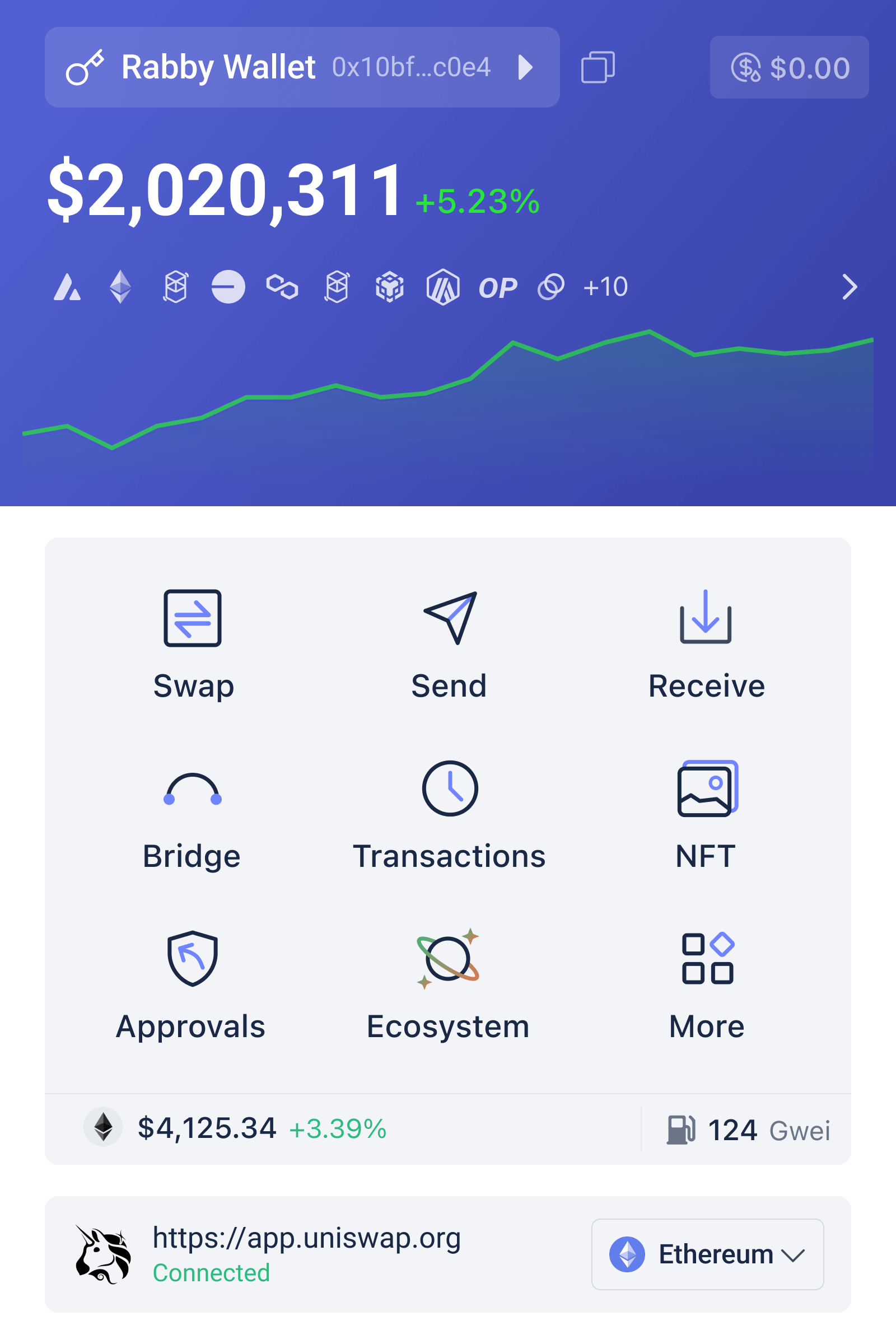
A wallet is a signing boundary, not a safety certificate
A browser wallet manages access to cryptographic keys and lets a user authorize blockchain transactions or messages. The key distinction is that a decentralized application (dApp) can prepare a request, but it generally needs the wallet to obtain the user’s approval before acting through that address. That approval is powerful: on-chain transactions are typically difficult or impossible to undo once confirmed.
This does not mean every approval is equally risky. A transaction may move a specific asset, interact with a lending protocol, or grant a contract permission to spend tokens later. The last case is easy to underestimate. A token approval can be broader and longer-lived than the immediate action that prompted it; the user may approve a spender without transferring the tokens at that moment. The risk is not just “signing a transaction,” but what authority the signature or approval gives, to whom, and for how long.
Wallet interfaces can make that boundary more legible by displaying transaction details and warnings. Rabby’s security-oriented experience is useful insofar as it helps users review requests before confirming them. Still, interface analysis has limits: a warning system may not recognize every novel contract behavior, and a readable summary cannot prove that a protocol will behave safely in every future circumstance.
Why EVM users benefit from transaction context
Ethereum Virtual Machine (EVM) networks share a compatible execution environment, so users can encounter familiar wallet workflows across multiple chains. That convenience also creates room for mistakes. A user may believe they are interacting with one network while a dApp is requesting an action on another, or may approve a transaction whose underlying contract call is less obvious than the website’s button label.
A wallet that surfaces the selected network and interprets transaction details can reduce the gap between a dApp’s language and what the blockchain request appears to do. This is a form of risk reduction, not risk elimination. The wallet sees the request it receives; it does not necessarily know the dApp’s full business logic, whether its front end has been compromised, or whether a protocol’s governance and upgrade mechanisms will change its behavior later.
For US users, the practical setting is often a familiar desktop browser, several open tabs, and a mix of established and newly discovered protocols. The convenience of keeping a wallet available in the browser is also part of its attack surface. A convincing fake download page, a malicious browser extension, or a compromised device can undermine careful transaction review before it begins.
Install deliberately, then treat every request as a separate decision
If you are preparing to install Rabby, use a trusted route and take a moment to confirm that the extension and publisher details match what you intended to install. A search result or sponsored placement is not, by itself, proof of authenticity. For a starting point, consult this rabby wallet download page, then independently verify the extension in the browser’s official extension store before installing it. Never enter a recovery phrase into a website just to “activate” a browser wallet.
During setup, protect the recovery phrase as the ultimate backup for the wallet. Anyone who obtains it may be able to control the associated assets, and a browser extension cannot make a phrase stored in a compromised computer private again. Use a unique, strong device password, keep the browser and operating system updated, and be cautious about installing extensions that do not have a clear purpose. Each additional extension is another piece of software with access to the browser environment.
Before approving a DeFi interaction, pause on three questions: what asset or permission is involved, which network is active, and what contract or account receives the authority? If the request is an approval, check whether the amount and spender make sense for the action. If the wallet’s explanation is unclear or conflicts with the dApp’s description, do not resolve the ambiguity by clicking through. Verify the action through a trusted channel or abandon it.
The important trade-off: convenience versus attention
Wallet warnings and transaction previews can help users notice mismatches, but they also create a subtle human-factors risk. If a system produces many prompts, people may begin treating them as routine obstacles. Security cues are most useful when users know what they are checking and can identify when a request falls outside their expectations. A green indicator or reassuring summary should not replace judgment.
Nor is a wallet review a substitute for evaluating the protocol itself. A correctly displayed transaction can still interact with a vulnerable contract, an economically fragile design, or a service whose risks the user has not assessed. Conversely, a complex-looking transaction is not automatically malicious. The interface can clarify what is being requested; deciding whether the protocol is trustworthy requires separate research and an understanding of the possible loss.
A practical rule is to match the strength of your review to the consequence and reversibility of the action. A small, familiar interaction may call for a brief check. A large token approval, a new protocol, or a transaction affecting funds you cannot afford to lose deserves a slower review. Where a protocol allows a narrower approval or a separate wallet for experimentation, those choices can limit exposure, though they add management overhead and do not remove smart-contract risk.
What to watch as wallet security evolves
Rabby’s September 5, 2026 project news describes it as a wallet for Ethereum and EVM chains. That positioning points to a continuing practical challenge: the more networks and applications a wallet supports, the more important accurate context becomes. Broader compatibility can simplify the user experience, but it also asks the wallet to interpret requests arising from varied contracts, interfaces, and network conditions.
The useful signal to watch is not simply a growing list of supported chains or more prominent warnings. It is whether users can understand the consequence of an action before signing, and whether the interface communicates uncertainty rather than implying certainty where analysis is incomplete. Better previews may help catch errors; they cannot guarantee that a contract is safe or that a user’s device is uncompromised. Security remains layered: careful installation, device hygiene, informed approvals, and protocol evaluation each address a different failure mode.
The clearest mental model is this: a wallet extension is a gate and a translator, not an insurer. Rabby can make the signing moment more informative for EVM activity, but the user still decides whether to grant authority. The safest habit is not to approve faster because a wallet looks sophisticated; it is to understand what the wallet is showing and stop whenever the request does not match the action you meant to take.
Frequently asked questions
Does Rabby guarantee that a DeFi transaction is safe?
No. A wallet can display transaction information and security cues, but it cannot guarantee a protocol’s code, future behavior, or the security of your device. Use wallet warnings as useful signals, not as proof that an interaction is risk-free.
Is a token approval the same as sending tokens?
Not necessarily. An approval can grant a contract permission to spend tokens later, within the scope of the permission. Review the spender and allowance rather than assuming that an approval only authorizes the immediate action shown by a dApp.
What should I do if a transaction preview is confusing?
Do not sign until you understand the request. Check the active network and the asset or permission involved, then verify the action through a trusted source. If the explanation remains unclear, canceling is safer than treating uncertainty as routine.
Author